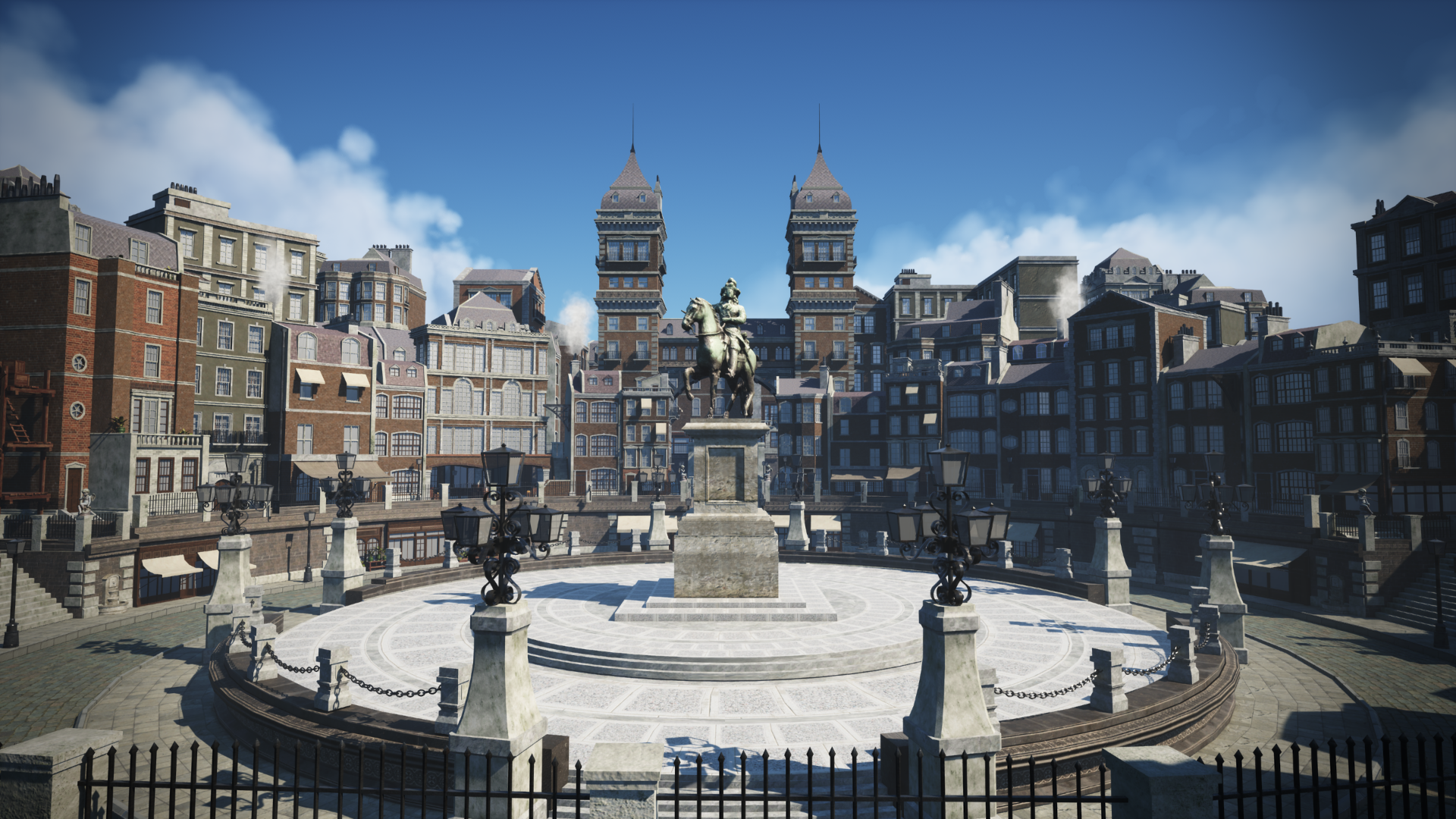

CENTRAL SQUARE | MODULAR ENVIRONMENT
Technical details
| Technical Field | Information |
| Project | Environment Central Square |
| Production | Professional Project |
| Video game | Tenebris Pictura |
| Studio | Pentadimensional Games |
| Rol | Senior Environment Artist |
| Category | Environment Art |
| Software | 3ds Max · ZBrush · Adobe Substance 3D Designer · Adobe Substance 3D Painter · Unreal Engine 5 |
| Responsibilities | Moodboard & Visual Research · Environment Composition · Modular Environment · Props Production · Materials Production · Lighting · FX Integration · Unreal Engine Integration |
| Deliverables | Environment · Modular Kits · Props · Materials |
| Pipeline | AAA Production Workflow |
| Rendering | Real-Time |
| Lighting | Lumen |
| Geometry | Nanite |
| Texture Resolution | 2K |
| Duration | ~1 month |


Project Goal
Environment Central Square is one of the environments developed for Tenebris Pictura, a video game by Pentadimensional Games.
As a Senior Environment Artist, I was responsible for the complete development of the environment, participating in all production phases, from visual research and environment planning to asset creation, environment composition, material development, lighting, atmospheric effects integration, and final implementation within Unreal Engine 5.
The project was developed following a AAA Production Workflow, applying a methodology based on modularity, resource reuse, and a production organization oriented toward maintaining a balance between visual quality, technical efficiency, and real-time performance.
Responsibilities
| Production pipeline |
| Moodboard & Visual Research → Environment Composition → Modular Kits → Props Production → 3D Scan Retopology → High Poly → Low Poly → UV Layout → Texel Density → Bake → Texturing → Materials Production → Lighting → Niagara FX → Unreal Engine Integration → Final Polish |
Workflow
Moodboard & Visual Research → Blockout → Modular Kits → Props Production → 3D Scan Retopology → High Poly → Low Poly → UV Layout → Bake → Texturing → Environment Assembly → Materials Production → Lighting → Niagara FX → Unreal Engine Integration → Final Polish

Environment breakdown
Production
Environment Central Square constitutes the architectural core of Tenebris Pictura, combining modular architecture, sculptural elements, lighting, and atmospheric effects to build one of the video game's main spaces. The composition organizes the different buildings and points of interest to direct the player's attention toward the central monument, reinforcing the visual reading and the environment's identity from any perspective.
The environment was developed following a AAA Production Workflow, combining different production methodologies based on the specific needs of each asset.
The architecture was built through a combination of Modular Kits and Unique Assets, utilizing modular systems for most of the buildings and exclusive elements for pieces that required a higher level of detail or a distinct visual identity. This approach allowed for production optimization, facilitated iteration during development, and maintained a balance between resource reuse, construction flexibility, and visual richness.
All Props were developed following a complete production pipeline, from Blocking to final texturing, including High Poly modeling, optimization via Low Poly, UV Layout development, Texel Density validation, and the Bake process, guaranteeing technical consistency among all assets before their integration into Unreal Engine 5.
The scene's main statue was based on a model obtained via 3D Scan, which was adapted for production through a comprehensive retopology process carried out with ZBrush and 3ds Max. Subsequently, the UVs, the Bake process, texturing, and its integration within Unreal Engine 5 were developed, allowing a high-resolution scan to be reused within an optimized real-time pipeline.
The materials were developed using Adobe Substance 3D Designer and Adobe Substance 3D Painter. As part of the project, different Tileable Materials were produced completely procedurally in Substance 3D Designer, complemented by Trim Sheets and unique materials when the environment's needs required it. This combination allowed for maintaining a coherent visual identity, optimizing resource reuse, and reducing the number of exclusive textures used during production.
The final integration was carried out in Unreal Engine 5, where the complete assembly of the environment, integration of all assets, material configuration, lighting adjustment using Lumen, and the implementation of different atmospheric effects using Niagara—including ambient smoke and volumetric particles—took place. Additionally, wet surfaces were incorporated through the Unreal Engine Puddles system to reinforce the environment's setting. The process concluded with the final polishing of the environment using Nanite to guarantee efficient real-time geometry representation.


Materials
The environment materials were developed through a procedural workflow using Adobe Substance 3D Designer, creating a collection of Tileable Materials designed to cover most of the architectural surfaces in the scene. These materials were subsequently combined with Trim Sheets and specific materials developed in Adobe Substance 3D Painter, allowing for high visual consistency, optimizing resource reuse, and reducing production costs without compromising artistic quality.
The gallery displays a selection of the procedural materials used during the development of the environment, illustrating both their structure and their application within the final scene.


Wireframe
Wireframes show the organization of the geometry, the construction of the different Modular Kits, and the distribution of the main architectural assets that make up the plaza. These views highlight the reuse of modules, the structure of the buildings, and the combination of modular elements and unique assets used to build the environment.


References
The project began with a Moodboard & Visual Research phase aimed at defining the architecture, urban style, composition, and general atmosphere of the plaza. These references served to establish the visual language of the scene and maintain a coherent identity throughout all production phases, from the initial blockout to the final polishing within Unreal Engine 5.


